

Game Theme
Greek Mythology
Game ThemeGreek Mythology |
ProviderPlaytech |
VolatilityHigh |
RTP95.49% |
Max Multiplier |
Min Bet0.10 CHF |
Max Bet200.00 CHF |
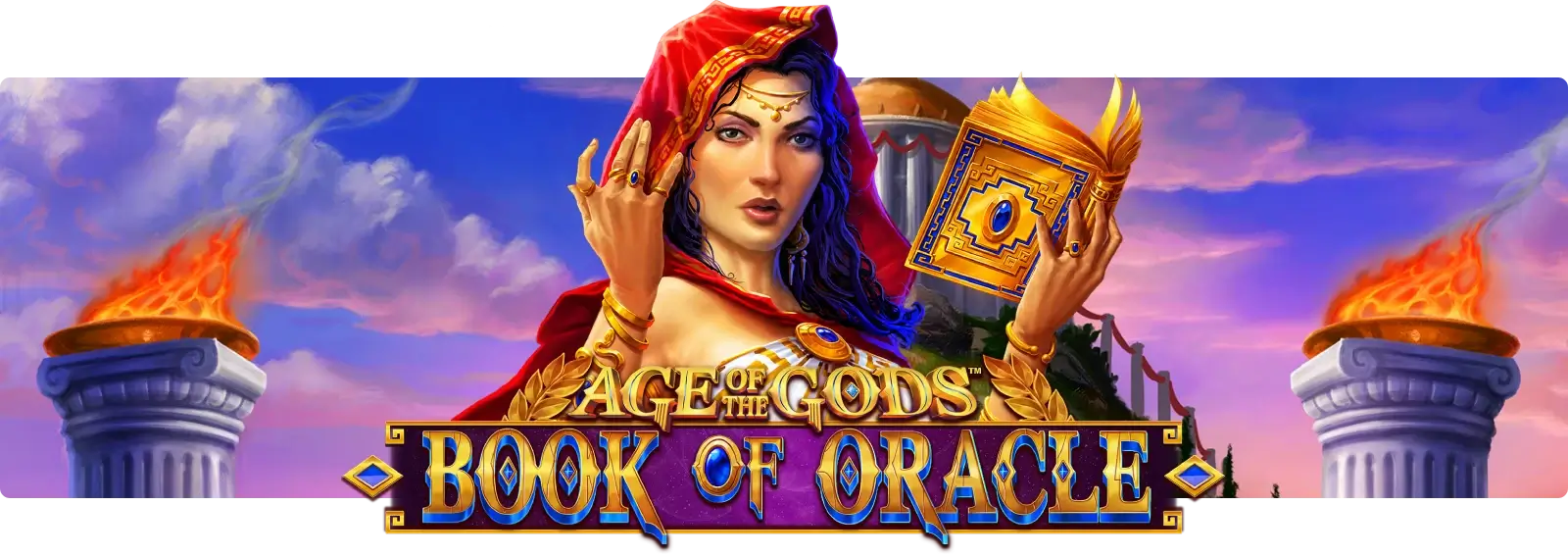
Playtech presents a mythological chapter centered on Ancient Greece with Age of the Gods: Book of Oracle, a title where the Delphic prophetess inspires both the atmosphere and the mechanics. Released in January 2021, this game belongs to the Age of the Gods collection, adopting the “Book of…” mechanic and adding a very visible twist on screen: a Book displayed above the reels that flips its pages each spin. The idea is simple and clear: when a symbol is revealed by this Book and contributes to a winning combination, it expands to cover the entire reel and a new win evaluation is applied. This “above-the-reel” reading gives a unique rhythm and adds anticipation to each spin.
The structure remains intentionally classic to serve as a foundation for these special effects: 5 reels, 3 rows, and 10 fixed paylines, with wins counted from left to right. Within this framework, symbols inspired by the Greek pantheon and rituals — the Oracle, statues, artifacts — set an immediately recognizable scene. Thematic coherence is established from the start: ancient architecture as background, a palette of vivid colors, and, above all, the presence of the Book symbol which acts as both Wild and Scatter.
Two technical axes structure the experience. On one side, the Book feature in the base game refreshes win evaluations via conditional expansion of a chosen symbol. On the other, Free Spins triggered by the Book-Scatter set a dedicated expanding symbol for the entire bonus, while maintaining the Book reveal sequence on each bonus spin: multiple expanding symbols can thus chain in a single spin. Added to these mechanics is the Age of the Gods progressive jackpots network and its coin selection mini-game, triggered randomly, awarding one of the four jackpots.
Without unnecessary overload, Book of Oracle focuses on clarity: familiar foundations, a strong theme, and some well-oiled mechanics. The Oracle remains the symbolic — and mathematical — pivot of the whole game: a full screen filled with this symbol pays up to 1,000x the bet, while the 10/J/Q symbols, at the bottom tier, cap at 75x. This clear contrast structures expectations and gives each expansion a tangible dimension.
The visual universe is rooted in Greek mythology, with an ancient architecture backdrop and vibrant colors. The Book, placed above the grid, becomes the central graphical actor: its pages flip on each spin, sometimes showing a blank page, sometimes a selected symbol. This simple effect animates the scene and introduces a visual crescendo when a combination forms. The overall design favors clear readability: symbols stand out sharply, expansions occupy the entire reel without ambiguity, and the screen “breathes” even when multiple effects occur during bonuses.
The style remains modern while respecting the classic iconography of the myth: statues, ritual artifacts, and sacred fires intertwine, with the Oracle as the flagship figure. Animations, without excess, serve the gameplay: symbol expansions, Book flipping, transition to the jackpot mini-game. The interface limits unnecessary ornamentation to highlight symbol state changes (standard vs. expanding) and, when relevant, the Pick’em jackpot sequence.
The game combines thematic symbols and royal values, each with a readable role in the 5x3 grid:
The hierarchy between the Oracle and the royals creates an easy-to-read scale: the more “sacred” the figure, the higher the potential impact of its expansion. This makes the Book appearing above the reels immediately significant: when the revealed symbol contributes to a line, the full-reel expansion triggers and recalculates wins.
The soundtrack maintains a calm and composed background during the base game, punctuated by dynamic audio cues during notable events: triggering an expansion, transitioning to Free Spins, opening the jackpot mini-game. Effects support the readability of the features without saturating them, emphasizing “ritual” moments: Book page flipping, synchronized symbol expansion, final reveal in the jackpot Pick’em. The result provides a clear auditory thread marking each stage of the session.
The main mechanics revolve around the Book above the reels and the symbol expansion ability, both in the base game and Free Spins. The Age of the Gods network completes the experience with four progressive jackpots awarded via a random mini-game. The table below summarizes and details each feature.
| Feature | Details |
|---|---|
| Grid Structure |
|
| Book Symbol (Wild/Scatter) |
|
| Book Feature – Base Game |
|
| Free Spins |
|
| Book Feature – also active in Free Spins |
|
| Free Spins Re-triggers |
|
| Paytable – Key Benchmarks |
|
| Age of the Gods Progressive Jackpots |
|
| Mobile Optimization |
|
Book of Oracle condenses a clear vision of the “Book of…” mechanics within the Age of the Gods aesthetic: a visible and active Book, symbol expansions whenever conditions allow, and a bonus overlay that permits multiple expanding symbols on the same spin. The 5x3 with 10 fixed paylines format provides a readable foundation, while the Oracle stands out in the paytable with a ceiling of 1,000x. The design prioritizes efficiency: a loop of anticipation in the base game with the Book flipping, followed by a bonus that builds on the idea and extends it through successive reveals on each Free Spin.
The Age of the Gods Jackpot network integrates naturally, following its Pick’em mini-game logic: a simple rule (match 3 identical symbols) and clear visibility of the tiers, from Power to Ultimate Power. The provided benchmarks — seeding in CHF and historical magnitude — highlight how this progressive layer adds a parallel dimension to the base cycle: the grid handles expansions and line recalculations, the mini-game manages a random and independent path. This dual structure preserves rhythm: one maintains activity every spin, the other punctuates the session with a special event.
Within the series, Age of the Gods Norse: Book of Dwarves serves as a natural comparison point. This episode features a 5x5 grid with 50 ways to win and adopts 3x3 “mega symbol” expansions at key moments. Its level progression system in bonuses (with extra spins and additional expansions) offers a more evolutionary experience. In contrast, Book of Oracle keeps the orthodox 5x3 format but allows overlapping expansions during Free Spins thanks to the active Book on each spin. In short: Dwarves expands the playing surface and layers its bonuses, Book of Oracle tightens the framework and multiplies expansion occurrences on the same base.
Another point of comparison is Divine Fortune by NetEnt, which also offers a mythological prism and uses progressive jackpots. The approach differs in the central mechanics: Divine Fortune emphasizes its own triggers and signatures, while Book of Oracle anchors everything in the “Book above – grid expansion” dialectic. The thematic kinship is clear; the difference lies in how the grid transforms (or does not) during a spin and in the role of the “regent” symbol (the Oracle here).
Two aspects stand out as identity markers. First, the continuity of the Book Feature between base game and Free Spins, with the possibility to stack multiple expansions on a single bonus spin: a design choice akin to a controlled fireworks display, where each expansion has its own evaluation sequence. Second, the readability of the symbol hierarchy — Oracle at the top, Royals at the base — combined with the 5x3 / 10 paylines framework. On this simple foundation, the game aligns effects unambiguously.
This positioning makes it a cohesive entry in the Age of the Gods collection: a recognizable visual identity, a central mechanic clearly presented, and progressive jackpots to punctuate the experience. Compared to neighboring titles that expand the play area or add complex bonus progressions, Book of Oracle focuses on recurring expanding symbols and the Book’s constant activity. The result is a direct reading of each spin, with animation peaks when multiple expansions occur in bonus. Unusually, the coexistence of a “designated” expanding symbol for the entire bonus and additional expanding symbols selected spin by spin by the Book creates a rare overlay in “Book” slots.
For Swiss4win.ch, this Greek chapter of Age of the Gods illustrates a measured approach: preserving a universal framework, integrating a strong idea (the Book above the grid), and using jackpots with control. The design prioritizes clarity of cues and sequence of effects, ensuring that the essence — the moment a symbol expands and recalculation occurs — remains at the forefront.
What is the grid and payline format?
5 reels, 3 rows, and 10 fixed paylines, with wins counted from left to right.
How does the Book symbol behave in the base game?
Visible above the reels, it reveals a symbol; if it forms a win, the symbol expands to cover the reel and a recalculation occurs. It also acts as Wild/Scatter.
How are Free Spins triggered and what do they do?
3, 4, or 5 Books award 10 Free Spins. A designated expanding symbol is active for the session; the Book remains active and can trigger additional expansions. 3+ Books during Free Spins grant +5 spins (unlimited).
Are there progressive jackpots and how are they won?
Yes, a random Pick’em mini-game is triggered: select pieces until 3 match to win one of 4 jackpots (Power to Ultimate Power).
What is the payout potential of key symbols?
A full screen of Oracles pays 1,000x the stake, while 10/J/Q top out at 75x under optimal conditions.
OL-AGG-20210413-006