

Game Theme
Genies
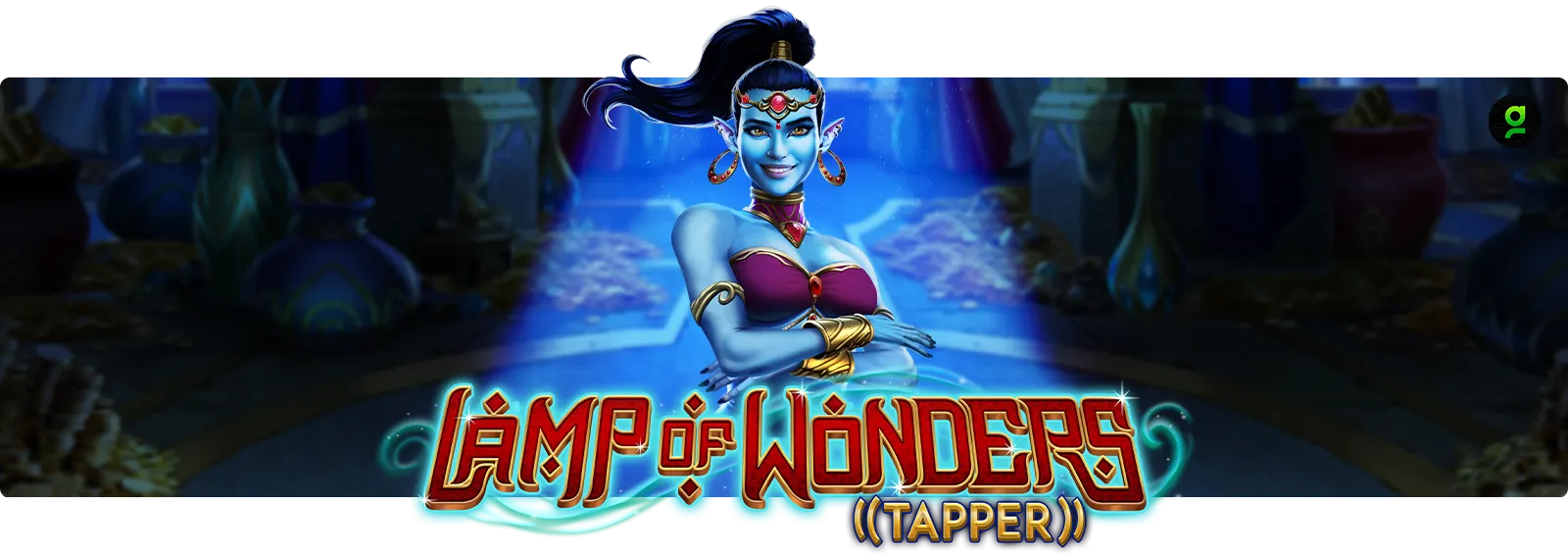
Game ThemeGenies |
ProviderGreentube |
VolatilityHigh |
RTP95% |
Max Multiplier5'002x |
Min Bet0.20 CHF |
Max Bet40.00 CHF |
Lamp of Wonders – Tapper takes place in an Arab-mystical universe where a mischievous genie appears around a magic lamp to award prize values. Developed by Greentube, this title departs from the traditional reels-and-paylines model to adopt a mechanic centered on the instant of allocation. The screen places the lamp at the center of the action, surrounded by 17 prize symbols, each carrying its own value. This setup transforms each interaction into a sequence of anticipation and resolution: the genie may appear, highlight at least three values, and award them immediately. In the most spectacular form, a magic wave traverses the entire area and unlocks all 17 prizes at once.
Beyond this direct allocation, the dynamic is enhanced with random elements. A prize multiplier may be revealed after the genie's intervention; in this case, the already-awarded prizes are instantly boosted by x2, x3, or x5. The cycle is simple to follow yet rich in micro-events: genie appearance, value selection, prize confirmation, then possible multiplier application. It remains consistent with the “tapper” spirit, where prize resolution relies on predefined symbols rather than reel combinations.
The theme draws on oriental storytelling codes: sparkling treasures, enchanted artifacts, and the genie’s playful benevolence. Random multipliers are integrated into the core mechanic, and Scatter symbols complement this landscape of occasional triggers. The game emphasizes clear and immediate allocation, with a potential ceiling of x1,000, framing the magnitude of the most rewarding sequences without deviating from the main focus: the lamp and its 17 values, with variation achieved via appearances and multipliers.
The setting immerses players in an adventure inspired by the Orient, dominated by the magic lamp and precious objects evoking treasures and spells. The visual identity relies on shimmering coins and enchanted artifacts that frame the space around the lamp, focusing attention on the 17 prize symbols positioned as promises of revelation. The iconography contrasts the gold of the coins and the shine of relics with the presence of a playful genie, whose arrival is the key visual event: appearance, highlighting of values, then confirmed reward.
Graphically, the approach seems to favor functional clarity: each value is clearly highlighted when chosen by the genie. The progressive illumination logic — first a few prizes, then potentially all 17 at once — structures the animation as a rise in intensity. In a “tapper” title, this visual language acts as an interface: it guides the eye, emphasizes the sequence of events, and delivers resolution unambiguously.
The overall aesthetic evokes classic tales from the Orient, with an emphasis on readability and sequential states (waiting, selection, assignment, enhancement). Lighting and reflections support this rhythm, especially when the multiplier is revealed at the end to transform the awarded sum into a total boosted by x2, x3, or x5.
The game’s structure dictates a clear audiovisual rhythm: genie appears, prizes are highlighted, assignment confirmed, then the multiplier may be revealed. Each step is naturally accompanied by a clear visual signal and a sound design intended to distinguish waiting from resolution. The oriental universe — treasures, magic, genie — supports a mysterious and luminous atmosphere, with punctuations marking key moments: value selection, massive unlocking of 17 prizes, and final enhancement.
The design of Lamp of Wonders – Tapper relies on a tight and readable chain of features. At the center: the magic lamp, which frames the interaction space; all around: 17 prize symbols. The driving event is the appearance of the genie, followed by highlighting value icons, their immediate assignment, and, possibly, the revelation of a prize multiplier x2/x3/x5. The presence of random multipliers and Scatter symbols adds inflection points to the cycle.
| Feature | Trigger | Effect | Technical Details |
|---|---|---|---|
| “Tapper” mechanic centered on the lamp | Interaction around the magic lamp | Activates the value assignment logic |
|
| Genie appearance | Occurs during interaction | Selects values and confirms their assignment |
|
| Full unlock | Most powerful wish configuration | Assigns all 17 prizes simultaneously |
|
| Prize multiplier | After assignment by the genie | Increases the total awarded by x2, x3, or x5 |
|
| Random multipliers | Session fluctuations | Introduce unplanned value increases |
|
| Scatter symbols | Presence indicated in the game | Complementary punctual event |
|
The lamp is not mere decoration: it is the hinge of the mechanic. Its central position structures the eye and the action, while the 17 prize symbols placed around it act as a “value map.” In each sequence, the goal is clear: determine which icons will be highlighted, then confirmed, and to what extent the final scene will be boosted by a multiplier. This readability gives the format a binary rhythm — waiting and resolution — very recognizable.
When the genie manifests, it highlights at least three prize symbols, which are immediately assigned. The selection acts as a visual clarification: the relevant icons stand out from the group, then the corresponding sum is confirmed. In the most advanced configuration, this leads to a full unlock of all 17 prizes, a resolution that elevates the animation into a different dimension, entirely focused on distribution.
This possibility represents the upper extreme of the assignment spectrum. Instead of a handful of icons, the entire “bouquet” of values shifts to the confirmed state. Visually, the effect resembles a propagation: the light signal travels across all symbols, and the final addition aggregates all values into a single resolution. This feature gives a strong identity to the circular grid: the periphery is not just decoration but a reservoir that, in the best scenarios, opens fully.
The multiplier occurs after assignment by the genie. This “epilogue” positioning has two effects: first, it confirms the base sum; then, it increases it by a net factor of x2, x3, or x5. In the game’s economy, this step acts as a final highlight: the distribution is done, then a coefficient boosts it. This temporal shift clarifies calculations and strengthens the readability of successive phases (selection, assignment, boost).
The presence of random multipliers suggests unplanned value increases, inserted into the regular flow of the cycle. The Scatter symbols, in turn, follow the same logic of punctual events: they enrich the trigger ecosystem and complement the lamp/genie duo with other inflection points. Overall, this maintains a regular variation in rhythm, without altering the simplicity of a mechanic based on clearly identified prize symbols.
Lamp of Wonders – Tapper highlights a unique and focused approach, where everything converges toward a clear and hierarchical distribution of values. The design axis is clear: a central lamp, 17 prize symbols around it, a genie who intervenes to select and assign, then a x2/x3/x5 multiplier that can boost the final sum. This sequence of steps, repeatable and readable, gives the experience a distinct identity: less disorientation, more focus on the moment of assignment, with a rise in intensity when the wave of magic ignites the entire circle of 17 prizes.
Compared to reel-based formats, this “tapper” model focuses on the immediate resolution of values rather than forming winning lines. Attention is on selection and confirmation, not symbol patterns. This structural difference gives the rhythm a new face: the key is the number of values highlighted by the genie, followed by the potential boost from the multiplier. The heart of the game becomes the granularity of distribution (at least three values), with the possibility of a full unlock of all 17 prizes as a climax.
The Greentube signature is evident in functional clarity and thematic styling. Choosing an oriental tale — playful genie, shining coins, magical artifacts — fits well with a mechanic centered on a lamp. The integration of random multipliers and Scatter symbols adds texture to sequences without artificially multiplying sub-rules. Overall, the system remains compact, with a limited number of concepts, each leveraged to generate significantly different outcomes: partial assignment, full assignment, final boost.
Compared to other digital entertainment productions, this title stands out for the assumed simplicity of its brief and its design choice: concentrate action on a single interaction and a fixed range of values. The potential ceiling at x1,000 provides a numeric perspective on the best configuration without complicating the system’s readability. The focus is not on the variety of effects, but on how a few targeted elements — genie, selection, assignment, multiplier — chain together and transform the same visual base.
Ultimately, Lamp of Wonders – Tapper offers a readable and thematic framework. The magic lamp serves as a pivot for transitions, the genie orchestrates distribution, and the x2/x3/x5 multiplier punctuates the best sequences with a clear boost. The option for a full unlock of all 17 prizes acts like a concluding fireworks display. The result is a title whose coherence is carried by a short, repeatable loop and clear visual signals that distinguish each stage of the assignment cycle.
How does the Tapper mechanic work?
The lamp is at the center, surrounded by 17 prize symbols. Highlighted values are assigned instantly, without reels or paylines.
What is the genie’s role during the game?
It appears to select at least three values and assign them. In the best case, it unlocks all 17 prizes at once.
When and how are multipliers applied?
After assignment, a x2, x3, or x5 can be revealed to boost the total already confirmed.
What do Scatter symbols mean here?
They are complementary random triggers that enrich the sequences around the lamp and the genie.
What is the maximum potential win?
A ceiling of x1,000 in the best configuration, without changing the game’s simple structure.
OL-AGG-20250304-276