

Game Theme
Egyptian Mythology
Game ThemeEgyptian Mythology |
ProviderYggdrasil |
VolatilityMedium-high |
RTP96.2% |
Max Multiplier |
Min Bet0.10 CHF |
Max Bet50.00 CHF |
In Valley of the Gods, a five-reel, five-row grid stands between stone statues in an ancient Egyptian setting. This Yggdrasil game begins with part of that grid covered by scarab blockers. Its central idea is visible before the first spin: a winning sequence can uncover positions that were initially unavailable. The swiss online casino page therefore presents a game whose layout evolves within a run of respins.
Twelve blocked positions reduce the opening grid to 45 winning ways. Matching symbols on adjacent reels from left to right can form combinations of three or more, and every winning spin grants one respin. Winning respins can grant further respins. The number of active positions grows as golden scarabs remove blockers, ultimately allowing 3,125 ways when the complete five-by-five grid is exposed.
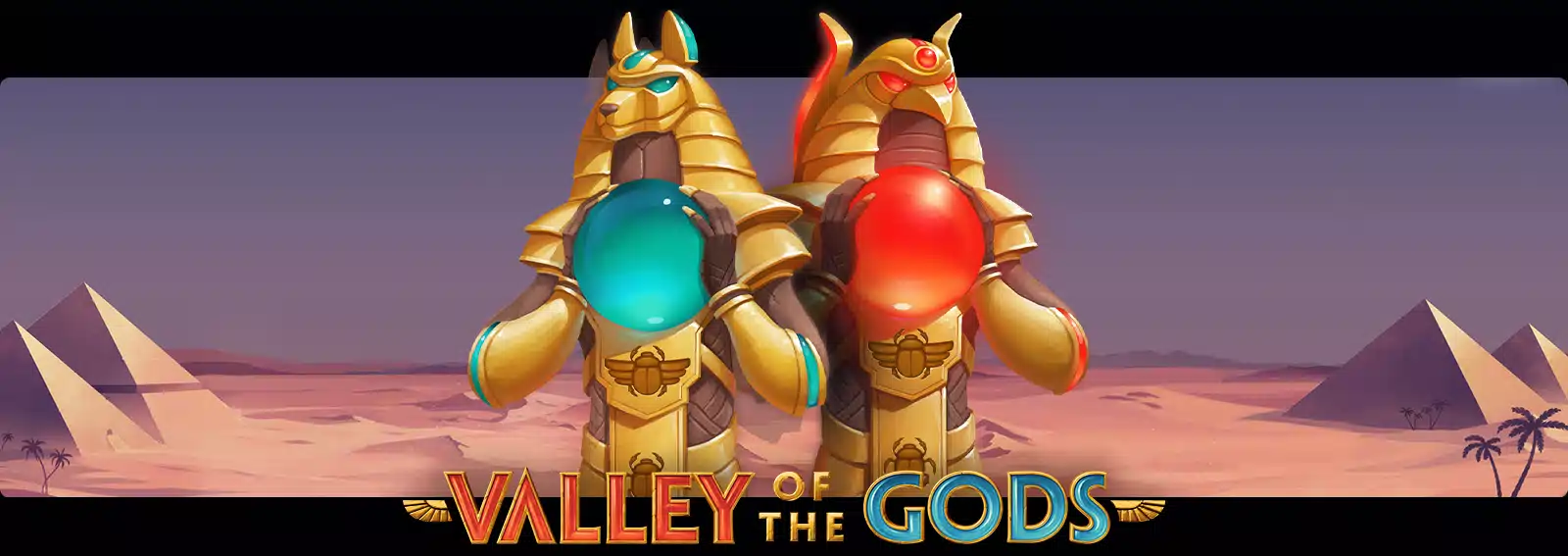
The Egyptian theme is tied to the actual game logic. Scarabs are more than ornaments: they travel from winning symbols to blocked spaces, and later to the statues beside the reels. Horus and Anubis belong to the symbol set as well as the visual setting. Their stone figures become important only after the blocked positions have been cleared during an uninterrupted sequence.
Ten regular paying symbols divide into four gods and six hieroglyphs. Horus is the highest-paying of the regular symbols, while the hieroglyphs occupy the lower group. The distinction gives the picture symbols a clear hierarchy without requiring a separate Wild to substitute for them. A combination still depends on matching symbols across consecutive reels rather than on a conventional fixed-line pattern.
Clearing all twelve blockers activates an expanded state with a multiplier and an extra life. Blue scarabs collected by Anubis can increase that multiplier; red scarabs collected by Horus can add lives. An extra life supplies another respin after a spin without a winning combination. These effects belong to the same continuing sequence that began with an ordinary win.
When a spin has no win and no extra life remains, the respin sequence ends. The original twelve blockers return and the next ordinary spin again starts from 45 ways. The game is thus organised around a temporary progression from covered corners to a fully open grid, rather than a separate free-spin screen. Its symbols, statues and scarab movements all explain a part of that progression.
The play area sits against walls suggestive of a pyramid interior, with two stone statues flanking the reels. Gold scarabs and warm stone colours establish the ancient Egyptian motif without obscuring the five-column grid. Subtle changes in background lighting and the apparent time of day alter the scene while the main action remains in place. The statues also provide a visual destination for scarabs collected later in a feature.
The initial display looks like five reels of five positions, although twelve corner positions are covered. Scarab-shaped blockers visibly mark the spaces that cannot yet contribute symbols. That arrangement makes the opening 45 ways easier to understand: the outline is large, but its usable area is smaller. As successive wins remove blockers, ordinary symbols occupy more of the same frame rather than appearing on a new board.
The four god portraits form the higher-paying symbol group: Tutankhamen, Horus, Bastet and Anubis. Horus is the strongest regular symbol. Six hieroglyphs form the lower-paying group and replace the usual card-rank imagery in this design. The portraits give the upper group recognizable figures, while the repeated glyph forms keep the lower group visually connected to the carved-stone setting.
A golden scarab leaving a winning symbol signals a change to the board. Early in the sequence it removes a blocker, exposing a position for subsequent respins. After all blockers disappear, coloured scarabs show a different purpose: blue tones feed the Anubis statue and red tones feed Horus. Their destination helps distinguish multiplier progress from extra-life progress without treating either colour as a substitute symbol.
The two statues are therefore functional parts of the interface as well as Egyptian decoration. Anubis receives blue scarabs that raise the multiplier in groups of five after its initial activation. Horus receives red scarabs that add lives in groups of five. Watching which statue receives a scarab clarifies which counter advances during a continuing series of respins.
Reviews describe majestic, mysterious music and lighter effects during reel movement. The short animated introduction and the changing illumination support the temple atmosphere, but the decisive visual feedback comes from blocked cells opening and scarabs moving to the statues. This distinction matters because a completed grid changes the available winning ways and enables the later modifiers; it is not merely a change of scenery.
A regular winning combination starts the sequence by awarding a single respin. The game checks adjacent reels from left to right for at least three matching symbols. If the respin also wins, another follows. This repeated condition makes the duration depend on successive outcomes; a predetermined set of free spins is not awarded at the start of the feature.
At the beginning, twelve scarab blockers cover positions in the corners of the five-by-five grid. A winning symbol releases a golden scarab that removes a blocker. Continued winning respins uncover further spaces, increasing the available ways from the initial 45 toward 3,125. A newly exposed space can then carry an ordinary paying symbol on a later respin, changing the combinations that the same grid can form.
Removing the last blocker marks a second stage rather than ending the respins. The full grid can use all 3,125 ways, and a 2x win multiplier becomes active. An extra life is also granted at that point. The transition connects a spatial change, the opening of all positions, to two separate modifiers that can affect the remainder of the active sequence.
After the grid opens, scarabs from winning blue, teal or green symbols collect at the Anubis statue. Each group of five blue scarabs raises the win multiplier by one from its initial 2x level. The multiplier applies to wins in this fully opened state. This is a counter that can advance during continuing respins, rather than a fresh multiplier chosen for each isolated base spin.
Scarabs from winning red, orange, purple or pink symbols collect at Horus. Five red scarabs add an extra life after the first life awarded on opening the grid. When a respin contains no winning combination, one available life is spent to obtain another respin. A life changes whether the sequence continues; it does not create a winning combination on the unsuccessful spin itself.
The run ends when a spin does not win and the extra-life reserve is empty. At that point the multiplier and expanded grid cease to apply, and all twelve blockers return to the initial arrangement. The next ordinary spin once again has 45 ways. The feature's order is therefore win, respin, blocker removal, full-grid modifiers, and eventual reset, with each stage governed by a visible condition.
Valley of the Gods makes the reel layout part of the feature rather than leaving it as a fixed backdrop. Its five-by-five outline is visible from the outset, but twelve scarabs restrict the opening state to 45 ways. The prospect of 3,125 ways follows from removing those specific obstacles in an uninterrupted chain. This gives the scarab motif a concrete function in the game's structure.
The free respin awarded after a win is the hinge between the ordinary game and the expanding grid. A further winning result keeps the chain alive and can clear another covered position. Consequently, the full layout is reached through successive events on the same board. The sequence has a different rhythm from a bonus that begins with a fixed number of rounds.
The higher-paying god portraits and lower-paying hieroglyphs also suit that changing board. As covered cells become available, there are more positions for those same ten symbols to occupy. Horus sits at the top of the regular hierarchy, while the other gods and glyphs remain distinct picture groups. No Wild substitution is needed to explain the central change in available combinations.
Horus and Anubis gain a second role when the grid is fully open. Their statues sort coloured scarabs into life and multiplier progress, making the modifiers legible in the Egyptian scene. Five scarabs at one statue affect the multiplier; five at the other add a life. The art therefore carries information about two mechanisms that affect the same ongoing respin run in different ways.
The extra life is especially important to the sequence's ending. It permits a further respin following a result without a winning combination, while a successful respin can continue the usual chain. Once no win and no life remain, the covered starting layout returns. That reset gives a clear boundary between one evolving run and the next ordinary spin.
Taken together, the carved setting, changing light, scarab blockers and statue counters tell the same mechanical story. A partially hidden grid opens, gains modifiers only when fully exposed, and returns to its original state when the chain concludes. The game's defining detail is the relationship between the visual reveal and the rules of continuation, not an unrelated extra screen or symbol type.
How does the grid open in Valley of the Gods?
The game starts with twelve scarab blockers covering positions in a five-by-five outline. A winning combination awards a respin, and golden scarabs from winning symbols remove blockers as the sequence continues. Clearing all twelve exposes the full grid and changes the available ways from 45 to 3,125.
What keeps the respin sequence going?
Every winning spin grants one respin, and a win on that respin grants another. Once the full grid has opened, an extra life can also supply a respin after a spin without a win. The sequence ends when a spin has no winning combination and there is no extra life left to spend.
Which symbols have the higher regular payouts?
The four Egyptian god portraits form the higher-paying regular group, with Horus at its top. Six hieroglyphs form the lower-paying group. Matching three or more of the same symbol on adjacent reels from left to right forms the regular combinations described for this game.
What do the Anubis and Horus statues collect?
Once every blocker is removed, Anubis collects blue scarabs associated with the multiplier. The multiplier begins at 2x and rises by one for every five blue scarabs collected. Horus collects red scarabs; each group of five adds a life that can extend the respin sequence after a nonwinning result.
What happens when the expanded state ends?
The expanded state lasts only for the active sequence of respins. If a spin does not win and no extra life remains, that sequence closes and the modifier no longer applies. All twelve blockers return, leaving the next ordinary spin with the opening 45 ways.
OL-AGG-20240611-565